How UFC Betting Odds Work: Reading Lines and Formats
 Available in US
Table of Contents
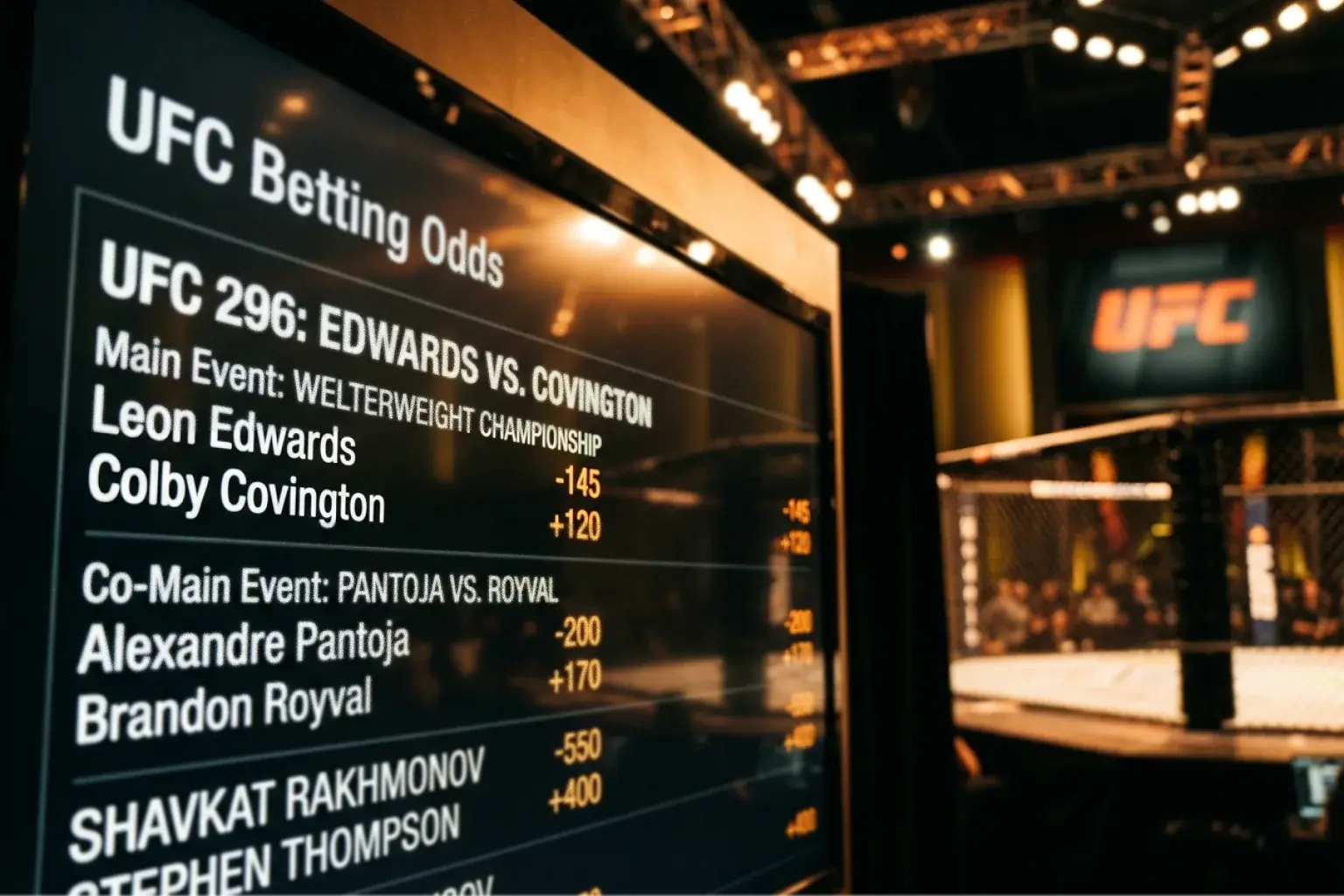
Anatomy of a UFC Odds Line
I still remember the first time I stared at a UFC odds board and felt like I was reading a foreign language. It was UFC 189 – Mendes versus McGregor – and I had strong opinions about the fight but zero idea what -175 or +145 actually meant for my wallet. That confusion cost me a sloppy wager and a valuable lesson: understanding odds isn’t optional in UFC betting, it’s foundational.
A UFC odds line is a compressed package of information. It tells you who the sportsbook expects to win, how confident the market is in that outcome, and exactly how much you stand to collect if you’re right. Every number you see – whether it starts with a minus sign, a plus sign, or a decimal point – encodes a probability assessment backed by millions of dollars in market activity.
Here’s what makes UFC odds unique compared to team sports. In a two-fighter contest, there’s no point spread cushion. No run line. No puck line. One person wins, one person loses, and the odds reflect that binary reality with brutal clarity. The favorite sits at a negative number, meaning you need to risk more than you stand to gain. The underdog sits at a positive number, meaning you risk less for a bigger potential return. That simple framework drives every bet you’ll ever place on a UFC card.
Favorites in UFC fights win roughly 65% of the time over the past decade. That number feels comforting until you realize the odds are priced to account for it – and then some. The sportsbook has already baked that win rate into the line, which means blindly backing favorites doesn’t generate profit. The edge, when it exists, lives in the gap between what the odds imply and what actually happens inside the octagon.
Before we break down formats, formulas, and the mechanics of how these numbers get set, internalize one principle: odds are not predictions. They’re prices. And like any price in any market, they can be wrong. Your job is to figure out when.
The Moneyline Format: Minus and Plus Explained
A friend once told me he bet on a -400 favorite “because negative means guaranteed.” He lost that fight and about $800 of his bankroll in a single card. The moneyline format is intuitive once you learn it, but it punishes anyone who skips the five-minute education.
The American moneyline format uses $100 as the baseline reference. A negative number tells you how much you must wager to profit $100. A positive number tells you how much profit you’d collect on a $100 stake. So when you see a fighter listed at -200, you’re risking $200 for a $100 return (total payout $300). When a fighter sits at +170, your $100 bet returns $170 in profit (total payout $270).
The minus sign marks the favorite – the fighter the market expects to win. The plus sign marks the underdog. In UFC specifically, moneyline spreads tend to be wider than in major team sports because individual combat is inherently more variable. A single punch can end a fight in three seconds, but the betting market still has to price a five-round chess match and a first-round knockout on the same line.
Let’s walk through a practical example. Say the card shows:
Fighter A: -180
Fighter B: +155
Fighter A is the favorite. To profit $100 on Fighter A, you’d need to wager $180. Fighter B is the underdog. A $100 bet on Fighter B profits $155 if he wins. Notice the gap between 180 and 155 – that gap is the sportsbook’s margin, and we’ll get into that shortly.
Favorites with lines heavier than -300 win at a rate above 88%, based on data from recent UFC seasons – 32 wins against just 4 losses in 2022 alone. That sounds like free money until you calculate the math. At -300, you risk $300 to profit $100. One loss wipes out three wins. Heavy favorites finish the fight early only about half the time, which means the other half go to distance where anything can happen on the scorecards.
Where moneyline betting gets interesting in UFC is the underdog side. Unlike the NFL or NBA, where massive upsets are rare, UFC underdogs win over a third of all fights. That frequency creates genuine opportunities if you know where to look – something we dig deeper into across different bet types and how they interact with moneyline pricing.
One more thing worth noting: the moneyline is always the backbone of UFC betting. Every other market – totals, props, method of victory – is built on top of the moneyline’s implied probability. If you understand this format cold, everything else becomes easier to decode.
Converting Odds to Implied Probability
Numbers on a screen don’t mean much until you translate them into something your brain processes naturally: percentages. Every odds line carries an implied probability – the win percentage the sportsbook’s price suggests – and converting to that number is the single most useful skill in sports betting.
The formulas are straightforward. For favorites (negative odds), divide the absolute value of the odds by that number plus 100. For a -200 favorite: 200 / (200 + 100) = 0.667, or 66.7% implied probability. For underdogs (positive odds), divide 100 by the odds plus 100. For a +150 underdog: 100 / (150 + 100) = 0.40, or 40% implied probability.
Let’s apply this to a real scenario. You’re looking at a bantamweight bout priced at -140 / +120.
The favorite’s implied probability: 140 / (140 + 100) = 58.3%.
The underdog’s implied probability: 100 / (120 + 100) = 45.5%.
Add those together: 58.3% + 45.5% = 103.8%. That total exceeds 100%, and the extra 3.8% represents the sportsbook’s built-in margin – the overround. In a perfectly fair market, both sides would sum to exactly 100%. The sportsbook inflates both sides slightly to guarantee profit regardless of outcome.
Why does this matter for your betting? Because implied probability is the baseline you compare against your own assessment. If you believe the underdog wins 50% of the time but the line implies only 45.5%, you’ve identified a potential value bet. If your analysis agrees with the implied percentage, there’s no edge and no reason to wager.
I run this conversion on every fight I analyze before I even look at matchup tape. It takes thirty seconds with a calculator – or you can do it in your head with practice – and it reframes the entire decision from “who do I think wins?” to “do I think this fighter wins more often than the price suggests?” That shift in thinking separates recreational bettors from analytical ones.
A common mistake I see is treating implied probability as the sportsbook’s actual prediction. It isn’t. It’s a price influenced by money flow, liability management, and market dynamics. The sportsbook doesn’t care who wins – it cares about balancing action on both sides. That distinction opens up opportunities when public money pushes a line away from true probability.
Understanding Juice: The Sportsbook’s Edge
I spent my first two years betting on UFC without fully grasping what juice was doing to my bottom line. I’d win 55% of my bets and wonder why my bankroll barely grew. The answer was sitting right in front of me, embedded in every single line I played.
Juice – also called the vig or vigorish – is the commission sportsbooks charge for taking your action. It’s not a separate fee on your receipt. It’s woven into the odds themselves. When you see a standard -110 / -110 line in other sports, both sides pay 10% juice. In UFC, the juice shows up differently because moneyline spreads vary wildly from fight to fight.
Remember that bantamweight example at -140 / +120? The implied probabilities summed to 103.8%. That extra 3.8 percentage points is the juice. To find the “true” probability of either outcome, you need to remove the overround by dividing each side’s implied probability by the combined total. So the favorite’s true implied probability becomes 58.3 / 103.8 = 56.2%, and the underdog’s becomes 45.5 / 103.8 = 43.8%. Now they sum to 100%.
The national hold percentage – the amount sportsbooks keep from all wagers after paying winners – climbed from 8.1% in 2022 to 9.1% in 2023 across US sports betting. UFC markets often carry slightly higher juice than mainstream sports because the betting volume is lower and sportsbooks need wider margins to manage their risk on individual fights.
What this means practically: even a skilled bettor hitting 54-55% of moneyline wagers at standard juice is barely breaking even after the vig. You need to either find consistently mispriced lines, shop for the best available odds across multiple sportsbooks, or focus on markets where the juice is thinner. Every percentage point of juice you save compounds over hundreds of bets into real money.
Decimal and Fractional Odds in UFC Markets
If you’ve ever opened a European sportsbook or glanced at a betting exchange, you’ve seen decimal odds – and probably found them refreshingly simple after wrestling with American format. Decimal odds represent your total return per dollar wagered, including your original stake. A line of 2.50 means a $100 bet returns $250 total ($150 profit + $100 stake). A line of 1.55 means a $100 bet returns $155 total ($55 profit + $100 stake).
Converting between formats is mechanical. To go from American positive odds to decimal: divide the odds by 100 and add 1. So +150 becomes (150/100) + 1 = 2.50. For negative American odds to decimal: divide 100 by the absolute value and add 1. So -200 becomes (100/200) + 1 = 1.50.
Fractional odds, dominant in the UK and Ireland, express profit relative to stake as a ratio. Odds of 3/1 (spoken “three to one”) mean you profit $3 for every $1 wagered. Odds of 2/5 mean you profit $2 for every $5 risked. Fractional format appears less frequently in UFC markets than decimal or American, but you’ll encounter it on UK-facing platforms and occasionally on betting exchanges.
Which format is “best” is entirely personal preference – the math is identical. I use decimal odds for quick mental calculations because the implied probability is simply 1 divided by the decimal number. A 2.00 line implies exactly 50% (1/2.00 = 0.50). A 1.40 line implies 71.4% (1/1.40 = 0.714). No separate formulas for favorites and underdogs, no positive/negative confusion.
Most US sportsbooks default to American format but let you toggle between all three in settings. If you’re comparing odds across international platforms – which becomes increasingly relevant as UFC’s global audience grows – being fluent in all three formats prevents costly misreads. I’ve seen bettors accidentally place the wrong wager because they confused decimal 1.80 (a moderate favorite) with American +180 (a clear underdog). Take thirty seconds to confirm your format before clicking.
How Sportsbooks Set UFC Opening Lines
There’s a moment every Tuesday or Wednesday before a UFC event when the opening lines first hit the market. That window, usually just a few hours, is the most valuable time in the entire betting cycle – and most recreational bettors miss it completely because they don’t understand where those numbers come from.
Sportsbooks build opening lines using a combination of algorithmic models, in-house odds compilers, and market intelligence. The models ingest fighter records, recent performance metrics, striking and grappling statistics, and historical outcomes in similar matchup profiles. An odds compiler – a human expert – then adjusts the algorithmic output based on qualitative factors the model can’t capture: training camp reports, weight cut concerns, stylistic nuances, and cage rust from long layoffs.
Trip Stoddard, bet365’s Head of Development, described UFC’s appeal for oddsmakers in direct terms when he noted that UFC’s constant event calendar and deeply engaged global fanbase create a compelling environment for real-time betting. That “always-on” schedule – 43 live events per year, mixing 13 numbered pay-per-views with 30 Fight Nights – means sportsbooks are pricing UFC matchups almost every weekend. The volume gives their models more data to calibrate against but also more opportunities to get lines wrong early.
Once the opening line is posted, the market takes over. Sharp bettors – professional or semi-professional players with strong track records – place their wagers first. Their action moves lines. If sharp money hammers the underdog at +200, the sportsbook adjusts the line toward +180 or +170, reflecting the implied intelligence of informed capital. Recreational bettors tend to enter later, often pushing the favorite’s line even heavier based on name recognition rather than analysis.
This dynamic creates a pattern I’ve tracked for years: opening lines are the closest thing to a “true” market price, mid-week movement reflects sharp correction, and day-of movement is often driven by public sentiment and late-breaking news like weight cut issues or injury reports. bet365 replaced DraftKings as UFC’s official US and Canadian betting partner in March 2026, and these structural transitions often shuffle which platform posts opening lines earliest – worth monitoring if you’re a line-shopping bettor.
The practical takeaway is simple. If you’ve done your homework on a fight card, place your bets as close to the opening as possible. Waiting until fight day almost always means worse prices on the side you want.
Reading Odds on a Full UFC Fight Card
Looking at a single fight’s odds is straightforward. Looking at a 12-fight card with main events, co-mains, prelims, and early prelims – each carrying its own moneyline, totals, and prop markets – can feel overwhelming. I’ve built a system over the years for processing a full card efficiently, and it starts with structure.
A standard UFC event features roughly 12 to 14 bouts. Numbered events (the pay-per-view cards) typically carry 13 fights across the main card, prelims, and early prelims. Fight Nights run slightly shorter at 11 to 13 fights. UFC stages 43 events annually, which means you’re processing close to 550 individual fights per year if you follow the full schedule.
Start from the bottom of the card and work up. The early prelim fights often feature lesser-known fighters, regional prospects, and octagon debutants. Odds in these bouts tend to be softer – meaning sportsbooks have less data to work with and their models are less precise. This is where value hides for bettors willing to study tape on fighters the general public has never heard of. I’ve found some of my best plays buried in the early prelims precisely because the market hasn’t priced the fight as efficiently as it does for a main event with two ranked contenders.
As you move up the card, betting limits increase and odds tighten. Main event lines are the sharpest on the board because they attract the most volume, the most professional action, and the most model attention from the sportsbook side. Finding mispriced main event lines is rare but not impossible – it usually happens when a significant stylistic factor gets overlooked in a matchup that looks routine on paper.
When scanning the card, I flag three categories of fights. First, strong opinion fights: bouts where my analysis disagrees with the implied probability by more than 5 percentage points. These get full breakdowns and potential wagers. Second, lean fights: matchups where I have a slight lean but the line is fair. These go on a watch list in case the line moves in my favor before fight night. Third, pass fights: either I have no edge or the fight is too unpredictable to assess with confidence. Passing is an underrated skill – not every fight deserves your money.
For bettors looking to sharpen their card-reading process, comparing odds across sportsbooks on the same card reveals where individual platforms have exposure and where pricing disagrees. A one-fight discrepancy of 10 to 15 cents between books isn’t unusual, and over a full season those pennies accumulate into meaningful edge.
UFC Betting Odds FAQ
These are the questions I hear most often from people getting into UFC betting. The answers are grounded in market mechanics and data rather than opinion.
What do negative and positive numbers mean in UFC odds?
Negative numbers identify the favorite and indicate how much you must wager to profit $100. A -200 fighter requires a $200 risk to earn $100 profit. Positive numbers identify the underdog and show how much profit a $100 bet produces. A +170 fighter returns $170 profit on a $100 wager. The system uses $100 as the reference point, but you can bet any amount – the ratio stays the same.
How are UFC odds different from other sports?
UFC odds center on the moneyline rather than point spreads, because there’s no scoring system that lends itself to a spread the way football or basketball does. This makes UFC odds more volatile – a single punch can flip the outcome – and creates wider moneyline ranges than you’ll see in team sports. It’s common to see a UFC favorite at -500 or an underdog at +400, ranges that barely exist in NBA or NFL markets. UFC favorites have won about 65% of fights over the past decade, which is lower than the favorite win rate in many team sports, making underdog betting more relevant here.
Why do UFC odds change before a fight?
Odds shift for three primary reasons. First, betting volume: when significant money lands on one side, sportsbooks adjust the line to balance their exposure. Second, information: training camp reports, injury disclosures, weigh-in results, and last-minute fight cancellations all trigger movement. Third, sharp action: professional bettors placing large wagers early in the week often cause the first and most significant line movements, with recreational money following later.
What is the vig in UFC betting and how does it affect payouts?
The vig (short for vigorish, also called juice) is the sportsbook’s built-in margin on every bet. It’s the reason implied probabilities from both sides of a fight add up to more than 100%. The US sportsbook hold percentage rose from 8.1% to 9.1% between 2022 and 2023, reflecting how much the house keeps across all wagers. For bettors, the vig means you need to win more than 50% of even-money bets to break even, and significantly more than the break-even rate on favorite-heavy plays. Shopping for lower-juice lines across multiple sportsbooks is one of the simplest ways to improve long-term returns.
What do negative and positive numbers mean in UFC odds?
Negative numbers mark the favorite and show how much you risk to profit $100. Positive numbers mark the underdog and show how much a $100 bet profits. A -200 favorite requires $200 to win $100; a +170 underdog returns $170 profit on $100.
How are UFC odds different from other sports?
UFC odds are moneyline-based rather than spread-based, creating wider ranges and more volatility. Favorites win about 65% of UFC fights, which is lower than most team sports, making underdog betting a bigger factor in MMA markets.
Why do UFC odds change before a fight?
Lines move due to betting volume on one side, new information like injury reports or weigh-in results, and sharp bettor action. Professional money typically moves lines early in the week, with public money pushing adjustments closer to fight night.
What is the vig in UFC betting and how does it affect payouts?
The vig is the sportsbook’s margin built into every odds line. It’s why both sides’ implied probabilities exceed 100%. The US sportsbook hold rate reached 9.1% in 2023. To overcome the vig, bettors need win rates above the break-even threshold and should shop for the best available odds.
Created by the "Bets ufc" editorial team.